
Last Updated: October 30, 2026
Quick Summary
How long does it take to build a new home in Florida depends on the home type and where you start counting. Production homes often take 5 to 9 months from contract to certificate of occupancy, semi-custom homes 12 to 18 months, and fully custom homes 18 to 30 or more months.
- Define the start and end points in writing before comparing builder timelines.
- Production homes already permitted can close in roughly 5 to 9 months from contract.
- Custom homes often need 3 to 6 or more months of design before permit review begins.
- Hurricane season from June through November can disrupt site prep, foundation, and framing.
- Submit a complete permit plan set to avoid resubmissions that restart the review clock.
Table of Contents
- How Long Building a New Home in Florida Really Takes
- Defining Your Start and End Points: Contract, Permit, or Move-In
- New Home Construction Stages From Design to Final Walkthrough
- New Home Building Permit Timeline in Southwest Florida
- How Long to Build a Custom Home Compared With Semi-Custom and Production Homes
- Factors That Delay Home Construction in Florida, Including Hurricane Season
- Booking Your Schedule Review Before Signing Your Build Contract
- Frequently Asked Questions
How Long Building a New Home in Florida Really Takes
Knowing how long does it take to build a new home in Florida depends on where you start counting. For a project-specific sense of the timing, see how long a new construction home typically takes. Builders often quote different numbers, and those numbers rarely cover the same stretch of time. Some estimates begin at contract signing. Others begin when the permit is released. Some stop at the final walkthrough, while others stop at move-in day.
Our goal here is simple: give you a realistic, Florida-specific picture so you can plan your move, your financing, and your rent or current lease with confidence.
New builds generally fall into a few broad ranges:
- Production and spec homes: often the shortest path, since the plan and materials are already set
- Semi-custom homes: a moderate timeline, with some choices made before construction begins
- Custom homes: the longest path, because design, approvals, and selections all add time
The rest of this guide breaks each phase down so you can compare builder timelines on equal footing.
Defining Your Start and End Points: Contract, Permit, or Move-In
Before you compare any timeline, decide what counts as the start and finish. This single step prevents most of the confusion we hear from buyers.
A common mistake is assuming a builder's "six-month build" includes everything. Often it covers only active construction, not the design, permit review, or closing steps that come before and after.
Here is a simple way to define the window:
- Start point: contract signing, permit submission, or permit approval
- End point: certificate of occupancy, final walkthrough, or closing day
- Move-in: usually a few days to weeks after closing, depending on your lender and move schedule
Watch out: A builder's advertised timeline may begin at permit release. If you signed the contract months earlier, your real wait may be much longer than the timeline suggests.
Ask the builder to put their timeline in writing, with the start and end points clearly named.
New Home Construction Stages From Design to Final Walkthrough
New construction moves through a predictable sequence. Knowing the stages helps you spot delays early.
Pre-Construction Design and Site Preparation
Design and site work come first. For a production home, this may take only a few weeks of paperwork and selections. A custom home can take several months of design revisions before anyone breaks ground.
Site preparation includes clearing the lot, grading, and setting up utilities. In Florida, soil conditions and drainage can change the schedule. Builders often need engineering reports before they can pour a foundation.
Framing, Roofing, and Rough-In Work
Once the foundation cures, framing goes up quickly. Crews then install the roof, windows, and exterior sheathing. Next come the rough-in trades: plumbing, electrical, and HVAC lines run through walls before drywall goes up.
Rough-in is where schedules slip most often, because each trade depends on the one before it. A delayed framing inspection can push back every trade behind it.
Interior Finishes, Inspections, and Closing
Drywall, paint, flooring, cabinets, and fixtures come next. Then the builder schedules the final building inspections and obtains the certificate of occupancy. Only after that can you do a final walkthrough and close.
Plan extra time here for punch-list fixes. Every new home has some, and they can take several weeks to clear.
New Home Building Permit Timeline in Southwest Florida
Permits often set the pace of the entire project. Your county or municipal building department reviews plans for code compliance before work can start, and review times vary by jurisdiction and by how complete the submission is.
When you ask how long does it take to build a new home in Florida, permit review is a big factor: expect it to take several weeks, and longer if the plans need revisions. Learn how permitting reviews and approvals can shift the build schedule in this area. Resubmissions restart the clock, so a complete, accurate plan set matters a great deal.
- Plan review: checks structure, energy code, and site layout
- Revisions: corrections requested by reviewers
- Permit release: construction officially begins on approval
Ask your builder which jurisdiction they work in and how long recent permits there have taken. Our guide explains when to schedule a final home inspection so it fits your timeline before contract deadlines.
How Long to Build a Custom Home Compared With Semi-Custom and Production Homes
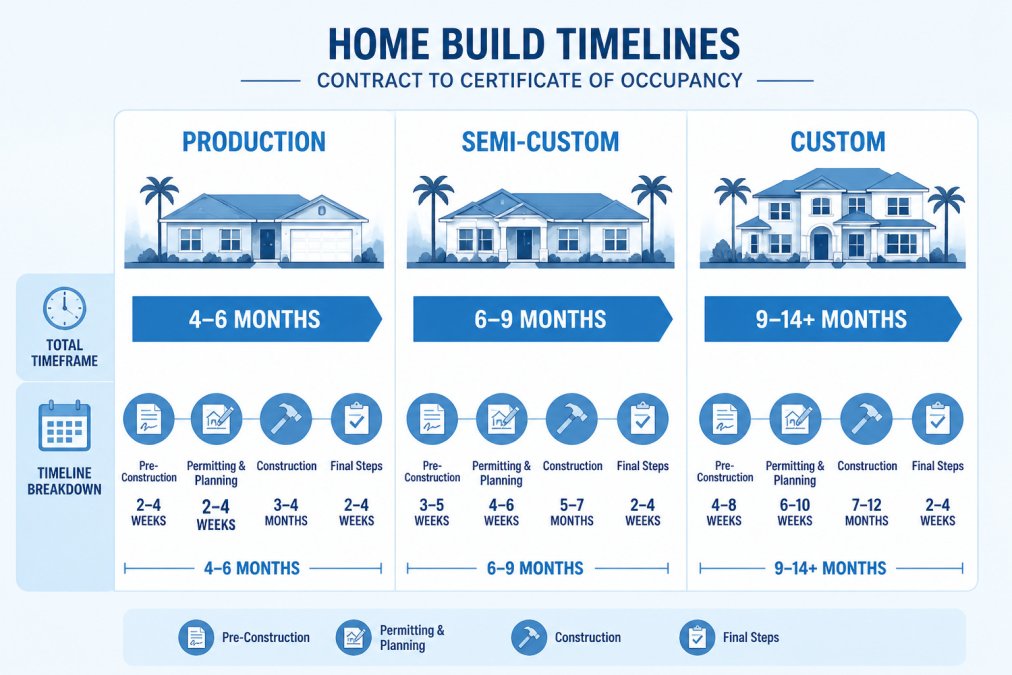
Home type shapes the timeline, and the comparison is most useful when you name the starting point for each clock. The table below separates design time, permitting time, and active construction so you can see where each home type spends its months.
| Home Type | Design & Selections | Permit Review | Active Construction | Typical Full Window (Contract to CO) |
|---|---|---|---|---|
| Production / spec (already permitted) | 0-4 weeks | Often already pulled | 5-8 months | 5-9 months |
| Production / spec (to-be-built) | 2-6 weeks | 4-10 weeks | 6-9 months | 9-14 months |
| Semi-custom | 6-12 weeks | 6-12 weeks | 8-11 months | 12-18 months |
| Fully custom | 3-6+ months | 8-16+ weeks | 10-14 months | 18-30+ months |
Production and spec homes. A home that is already permitted and under construction, or one where the builder owns the lot and has a repeatable plan, generally offers the shortest path. Because the floor plan, finishes, and vendor packages are pre-set, the design phase collapses to a selection appointment or two.
Semi-custom homes. These add a real design phase, structural options, elevation choices, and finish selections, plus a longer plan review because the submission is no longer a cookie-cutter set.
Fully custom homes. Custom builds carry the longest window because design, engineering, and approval happen sequentially and often iteratively.
Where the clock starts matters more than the label. A builder's '12-month custom home' may count from permit release, not contract signing. If design and permitting took eight months before that, your true contract-to-move-in window is closer to 20 months. Always ask three questions: When does your quoted timeline start?
Factors That Delay Home Construction in Florida, Including Hurricane Season
Mapping which construction stages are most exposed to which disruptions helps you build contingency into the right part of the schedule instead of padding the whole timeline.
| Construction Stage | Most Vulnerable To | Practical Contingency |
|---|---|---|
| Site prep, clearing, grading | Heavy rain, saturated soil, drainage issues | Schedule earthwork in the drier months where possible; require a soils and drainage plan before mobilization |
| Foundation and slab pour | Rain, pump and concrete truck availability, inspection scheduling | Build 1-2 weeks of weather buffer; confirm concrete supplier lead times in writing |
| Framing and dry-in | Wind, storms, lumber and truss lead times, framing crew availability | Order trusses and windows early; dry-in before hurricane season peak if the schedule allows |
| Rough-in trades (plumbing, electrical, HVAC) | Trade stacking, inspection backlogs, failed rough-in inspections | Sequence trades with written start dates; pre-inspection walkthroughs to catch code issues |
| Drywall, finishes, cabinets | Humidity and curing, cabinet and fixture lead times, selection changes | Lock selections before drywall; order cabinets at rough-in, not after |
| Final inspections and CO | Inspection backlog, punch-list corrections, utility connections | Request inspection slots early; complete punch list in parallel with final inspections |
Hurricane season mechanics. The Atlantic hurricane season runs June 1 through November 30, with peak activity typically from mid-August through October.
Permitting and plan review. Incomplete submissions and correction rounds are the most controllable delay on the list.
Material and labor availability. Lead times for windows, cabinets, appliances, and trusses can move independently of the construction schedule. Finishes can stall waiting on cabinets or windows even when the shell goes up on time.
Design changes after permit. Mid-build changes are expensive in both dollars and days because they can trigger revised plans, re-review, and reordering. Freeze structural and finish selections before permit submission where possible.
Inspection failures. A failed inspection means corrections, a reinspection request, and a new inspection slot, often a week or more per cycle. Pre-inspection walkthroughs with the trade and superintendent reduce this risk.
Practical schedule tracking. Keep a milestone log with promised and actual dates for permit submission, permit release, foundation, dry-in, rough-in inspections, cabinet order, final inspection, and certificate of occupancy. Review it with your builder at each milestone rather than at the end. Delays are easier to resolve when they are identified at the stage where they occur. If a delay does hit, learn how to handle new build delays without losing your deposit.
Booking Your Schedule Review Before Signing Your Build Contract
Before you sign, review the builder's timeline against everything above. Look for the start and end points, the permit assumptions, and how delays are handled.
At New Home Hub SWFL, we help buyers compare builder schedules, check written specifications, and identify timing gaps early. Our Southwest Florida home builder ratings guide covers review sources and verification steps for comparing builders. Our team can also support your review of the contract and your timeline expectations. You can explore your options and book a schedule review before you commit to a build.
Frequently Asked Questions
How long does it normally take to build a 2,000-square-foot house in Florida?
A 2,000-square-foot single-family home in Florida commonly takes about 6 to 9 months of active construction after permits are released, with the full process from contract to move-in often running 9 to 12 months or longer. Semi-custom and production builders with established floor plans tend to land at the shorter end, while fully custom designs with site-specific engineering usually take longer. Actual timing depends on permit review speed, lot preparation, material availability, and weather, so ask any builder for a written schedule with milestone dates before you commit.
Can a house be built in 3 months?
A house can be framed, dried in, and roughed in within a few months under favorable conditions, but completing a full new home in 3 months is rare in Florida. Permit review, foundation curing, inspection scheduling, and the finish phase typically add time that a three-month window does not allow. Some production builders advertise quick-move-in homes with shorter timelines, but these are usually already permitted and partially built, so verify exactly where the home stands in the process.
How long do permits and inspections take for a new home?
Building permit review for a new single-family home in Southwest Florida often takes several weeks, and can stretch longer when plans need revisions or when jurisdictions are busy. Inspections are scheduled at key stages such as footing, foundation, framing, rough-in plumbing and electrical, insulation, and final, and each one must pass before the next phase proceeds. Ask your builder which county or city office reviews the plans and how far out inspections are currently being scheduled.
What factors can delay a new-home construction timeline?
The most common delays include slow permit approval, material shortages, labor availability, weather such as summer rains and hurricane season, and failed inspections that require rework. Design changes requested after construction starts also push schedules back. Reviewing the written schedule, tracking milestones, and asking the builder to notify you of delays early can help you spot problems before they compound.
Sources: Florida building timelines vary widely by builder, jurisdiction, and home type. For official building code and permit requirements, consult your local building department and the Florida Building Code, Florida Department of Business and Professional Regulation.
